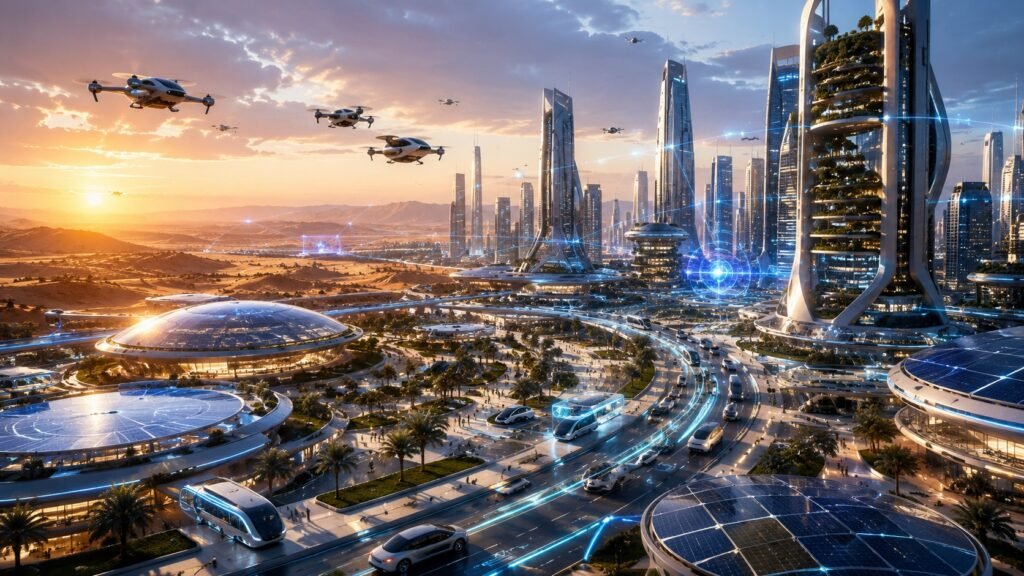
Imagine living in a city where traffic lights adjust automatically to prevent congestion, public transportation arrives exactly when needed, waste collection is optimized by smart sensors, and artificial intelligence manages everything from energy consumption to public safety.
This isn’t a scene from a science-fiction movie. It’s a vision that some countries are actively working to make reality.
Around the world, governments are investing billions of dollars in smart city projects, but one ambitious project stands out from the rest: the effort to build a city designed from the ground up around artificial intelligence.
Supporters believe these AI-powered cities could solve some of humanity’s biggest urban challenges. Critics worry about privacy, surveillance, and the growing role of machines in everyday life.
The question is simple: what happens when artificial intelligence becomes the operating system of an entire city?
The Rise of Smart Cities
Modern cities face increasing pressure from population growth, traffic congestion, pollution, housing shortages, and rising energy demands.
Traditional urban planning often struggles to keep pace with these challenges.
This has led governments and technology companies to explore a new concept: smart cities.
A smart city uses digital technologies, sensors, data analytics, and artificial intelligence to improve how urban systems operate.
Instead of relying solely on human decision-making, AI can process enormous amounts of information in real time and make rapid adjustments to city services.
Examples include:
- Intelligent traffic management
- Smart energy grids
- Predictive maintenance
- Autonomous transportation
- Automated public services
- Environmental monitoring
The goal is to create cities that are more efficient, sustainable, and livable.
The Ambitious Vision of NEOM
Perhaps the most talked-about AI-driven city project is NEOM, a massive development being built in Saudi Arabia.
The project aims to create a futuristic urban environment powered by advanced technologies, renewable energy, and artificial intelligence.
One of its most famous components is “The Line,” a planned linear city stretching across the desert.
Unlike traditional cities, The Line is designed around people rather than cars.
Residents would theoretically have access to essential services within minutes, reducing the need for long commutes.
AI systems would help coordinate transportation, energy distribution, environmental management, and public services.
The project represents one of the most ambitious attempts ever made to integrate artificial intelligence into the foundation of urban life.
How AI Could Run a City
Artificial intelligence can process information far faster than humans.
When connected to thousands or even millions of sensors throughout a city, AI can make real-time decisions that improve efficiency.
Smart Traffic Management
Traffic congestion costs cities billions of dollars every year.
AI-powered traffic systems can:
- Analyze traffic flow instantly.
- Adjust traffic signals automatically.
- Detect accidents quickly.
- Recommend alternative routes.
The result could be shorter travel times and lower emissions.
Intelligent Energy Systems
Smart grids use AI to balance electricity supply and demand.
These systems can:
- Reduce energy waste.
- Integrate renewable energy sources.
- Detect outages faster.
- Improve overall efficiency.
As cities move toward renewable power, AI could play a crucial role in managing complex energy networks.
Predictive Maintenance
Infrastructure failures can be expensive and dangerous.
AI systems can monitor:
- Roads
- Bridges
- Water systems
- Public transportation
By identifying problems before they become serious, cities can reduce repair costs and improve safety.
Transportation Without Drivers
Many AI city concepts include autonomous transportation systems.
Self-driving vehicles could eventually:
- Reduce traffic accidents.
- Improve mobility.
- Lower transportation costs.
- Increase efficiency.
Instead of owning private vehicles, residents may rely on autonomous ride-sharing networks operating around the clock.
While fully autonomous transportation is still developing, many experts believe it will become increasingly common over the next decade.
Can AI Improve Public Safety?
Public safety is another area where AI could have a major impact.
AI systems can analyze information from:
- Cameras
- Sensors
- Emergency calls
- Environmental monitors
Potential benefits include:
- Faster emergency response times.
- Improved disaster preparedness.
- Better resource allocation.
- Enhanced situational awareness.
However, these technologies also raise important concerns about surveillance and privacy.
The Privacy Debate
Not everyone is excited about AI-controlled cities.
One of the biggest concerns is privacy.
Smart cities collect enormous amounts of data, including information about:
- Transportation habits
- Energy consumption
- Public movements
- Environmental conditions
Critics worry that excessive data collection could lead to increased surveillance and reduced personal freedoms.
Supporters argue that strong regulations and transparency can help protect citizens while still delivering the benefits of AI-driven services.
The challenge will be finding the right balance between innovation and privacy.
Environmental Benefits
One of the strongest arguments in favor of AI-powered cities is sustainability.
Artificial intelligence can help reduce environmental impacts by:
- Optimizing energy use.
- Managing renewable power generation.
- Reducing traffic congestion.
- Improving waste management.
- Monitoring air quality.
As climate concerns continue to grow, many governments see AI as an important tool for building greener urban environments.
Could More Countries Follow?
Saudi Arabia is not the only country investing in smart city technology.
Projects are underway across:
- United Arab Emirates
- Singapore
- South Korea
- China
- Japan
- United States
Many existing cities are gradually introducing AI-powered systems without completely rebuilding from scratch.
Over time, today’s cities may evolve into highly connected urban ecosystems that rely heavily on artificial intelligence.
What Life Might Look Like in an AI City
Imagine waking up in a city where:
- Your home automatically adjusts energy usage.
- Traffic congestion is nearly eliminated.
- Public transportation arrives exactly on schedule.
- Air quality is monitored continuously.
- Infrastructure repairs happen before problems become visible.
Many of these capabilities already exist in limited forms today.
The difference is that future AI cities would connect all these systems into one intelligent network.
Final Thoughts
The idea of a city run largely by artificial intelligence may sound futuristic, but it is rapidly becoming reality.
Projects like NEOM offer a glimpse into how technology could reshape urban life over the coming decades. While challenges surrounding privacy, cost, and governance remain, the potential benefits are enormous.
Whether AI-powered cities become the global standard or remain experimental showcases of innovation, one thing is clear: the future of urban living will likely be far more intelligent, connected, and automated than the cities we know today.
The age of the AI city may have already begun.